Artificial intelligence is no longer reserved for tech giants with massive research labs. With AI as a Service, any organization can plug into powerful AI capabilities on demand, turning data into smart decisions, personalized experiences, and automated workflows — without having to build complex infrastructure from scratch. From AI applications for business call centers to streamlining operations, the benefits of AI in customer support are transforming the way companies interact with their customers.
This guide explains what AI as a Service is, why it matters, and how you can use it to unlock fast, measurable business value.
Unlocking the Power of AI for Your Business
Adopting AI doesn’t have to be overwhelming. Many organizations now take advantage of scalable cloud computing solutions for AI projects to deploy intelligent systems quickly and cost-effectively. These systems can adjust automatically to changing workloads, allowing businesses to use AI without heavy upfront investments. Understanding high-performance computing for complex data analysis also helps companies maximize the efficiency of AI-driven operations.
For marketing teams, AI provides actionable insights that enhance customer engagement. By using predictive analytics to improve marketing strategies, companies can better understand customer behavior and tailor campaigns effectively. Similarly, learning how to leverage AI tools to optimize online campaigns allows businesses to increase conversion rates and deliver personalized experiences at scale.
Even financial institutions are benefiting from AI integration. Exploring advanced AI techniques for financial decision-making helps firms analyze large datasets, identify patterns, and reduce operational risk. These applications highlight why AI as a Service is becoming essential across multiple industries, driving efficiency, accuracy, and smarter decision-making.
By embracing these innovative solutions, companies can enhance customer satisfaction, streamline workflows, and achieve measurable growth, all without needing to build AI infrastructure from scratch. The organizations that harness these AI capabilities effectively are positioning themselves for long-term success in a competitive market.
Top 10 AI Contact Center Solutions for Businesses
1. Bright Pattern – All-in-One AI Contact Center Solution
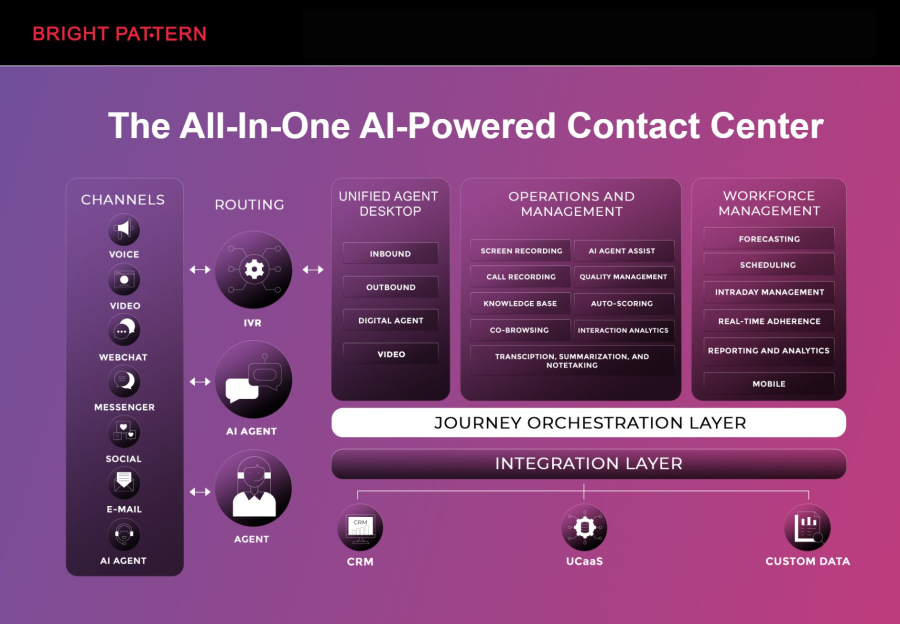
Bright Pattern stands out as a comprehensive platform that enables businesses to implement AI-driven contact center solutions seamlessly. Its cloud-based architecture allows organizations to scale quickly and integrate advanced AI capabilities without building complex infrastructure.
Key features of Bright Pattern’s AI contact center solution:
- Omnichannel support including voice, chat, email, and social media
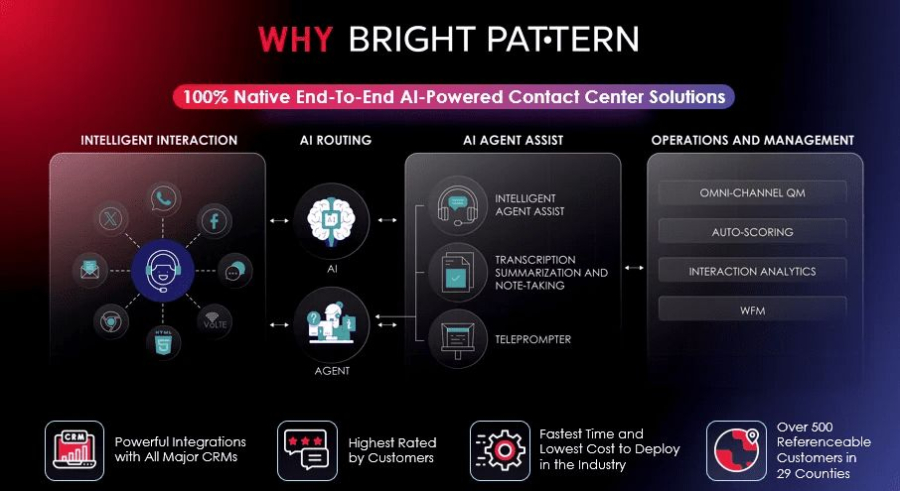
- Intelligent routing using AI to match agents with the right customers
- Automated workflows and virtual agents for 24/7 customer service
- Real-time analytics to optimize call center performance
- Integration with CRM and business tools to enhance customer interactions
By leveraging AI as a Service, Bright Pattern empowers businesses to deliver fast, personalized, and efficient customer support while reducing operational costs. Companies can also deploy AI-powered chatbots and voice assistants that learn from interactions, improving service quality over time.
2. Genesys Cloud CX
Genesys Cloud CX provides AI-enabled call center solutions that focus on predictive routing, automated chatbots, and performance analytics. Businesses can enhance agent productivity and deliver seamless customer experiences with minimal setup.
3. Five9 Intelligent Cloud Contact Center
Five9 offers a robust cloud contact center platform that integrates AI to automate routine tasks, support self-service channels, and analyze customer data to optimize engagement strategies.
4. NICE inContact CXone
CXone leverages AI as a Service to provide predictive engagement, workforce optimization, and sentiment analysis. This solution helps contact centers improve first-call resolution rates and overall customer satisfaction.
5. Talkdesk CX Cloud
Talkdesk combines AI and automation to deliver enhanced call routing, smart virtual agents, and workflow optimization. The platform is designed to increase agent efficiency while improving customer experiences.
6. Avaya OneCloud CCaaS
Avaya’s OneCloud CCaaS platform uses AI to provide intelligent routing, voice recognition, and automated assistance. Businesses can scale contact center operations efficiently with cloud-based AI tools.
7. RingCentral Contact Center
RingCentral integrates AI for real-time analytics, automated responses, and omnichannel support, helping companies provide consistent customer experiences across all channels.
8. 8x8 Contact Center
8x8 offers AI-powered call center solutions with smart routing, virtual agents, and detailed reporting features. Its platform enables businesses to monitor performance and optimize workflows effectively.
9. Cisco Webex Contact Center
Cisco Webex uses AI to enhance agent productivity, provide predictive insights, and enable intelligent self-service options. The solution is ideal for businesses looking to modernize their contact center operations.
10. Zendesk Talk
Zendesk Talk integrates AI to support ticketing, automated responses, and analytics, allowing teams to focus on high-value interactions while improving overall service efficiency.
What Is AI as a Service (AIaaS)?
AI as a Serviceis a delivery model where artificial intelligence capabilities are provided over the cloud as ready-to-use services. Instead of buying servers, hiring large data science teams, and building models from the ground up, you tap into AI through APIs, platforms, or prebuilt applications and pay based on usage.
At its core, AIaaS turns AI into a utility: you consume it when you need it, scale it up or down instantly, and only pay for what you use.
Key characteristics of AIaaS
- On-demand accessto AI tools, models, and infrastructure.
- Pay-as-you-go pricinginstead of large up-front investments.
- Managed infrastructurehandled by the provider, not your IT team.
- Pretrained modelsthat can often be used with little or no training data.
- APIs and platformsthat developers can integrate directly into products and workflows.
Why AI as a Service Is Exploding Now
Several trends have converged to make AI as a Service both practical and highly attractive for businesses of all sizes.
- Powerful cloud infrastructuremakes it possible to run large, complex models efficiently and cost-effectively.
- Mature AI modelsfor language, vision, recommendation, and prediction are now widely available and battle-tested.
- Developer-friendly toolsallow teams to add AI to products using common programming languages and simple APIs.
- Pressure to innovatepushes organizations to deliver smarter, more personalized experiences quickly — often with limited in-house AI skills.
The result: AIaaS has become a practical shortcut to advanced capabilities that once required years of R&D and huge budgets.
Business Benefits of AI as a Service
AI as a Service offers a powerful blend of speed, flexibility, and cost efficiency. Here are the standout benefits.
1. Lower costs and reduced risk
Building AI systems the traditional way involves major up-front costs: hardware, licenses, data storage, specialist hires, and long development cycles. AIaaS flips this model.
- No large capital expenditureon specialized hardware or software.
- Minimal setup time— often hours or days instead of months.
- Flexible pricingthat lets you experiment, learn, and scale only when you see value.
- Reduced project riskbecause you can prototype quickly and shut down what does not work.
2. Faster innovation and time to market
Because the heavy lifting is handled by the AIaaS provider, your teams can focus on business logic, user experience, and differentiation.
- Rapid prototypingof new AI-powered features in days, not quarters.
- Quick integrationinto existing applications via APIs and SDKs.
- Continuous access to improvementsas providers update their models and infrastructure.
The payoff: more experiments, more learning, and a faster path from idea to revenue-generating solution.
3. Access to advanced capabilities you could not build alone
Many state-of-the-art AI models require enormous compute resources and expert teams to build and maintain. Through AIaaS, you gain access to this sophistication instantly.
- Natural language processingfor chatbots, summarization, translation, and content generation.
- Computer visionfor image recognition, document understanding, and quality inspection.
- Predictive analyticsfor demand forecasting, customer churn prediction, and risk scoring.
- Recommendation enginesfor personalized products, content, or offers.
4. Easy scaling as demand grows
AI workloads can be unpredictable: a new feature or campaign can suddenly drive massive usage. With AIaaS, scaling is built in.
- Automatic scalingto handle traffic spikes without performance drops.
- Global reachby running workloads closer to your end users.
- Elastic capacityso you pay more only when you actually use more.
5. Focus on your core business, not infrastructure
Because the AIaaS provider manages servers, updates, and model maintenance, your teams can concentrate on what truly sets you apart: your customers, your data, and your domain expertise.
This shift in focus often leads toleaner teams, faster decisions, and more strategic use of AIacross the organization.
Common AI as a Service Use Cases
AI as a Service can enhance nearly every function of a modern organization. Here are some of the most impactful use cases.
Customer experience and support
- Virtual assistants and chatbotsthat answer common questions 24/7 and route complex issues to human agents.
- Intelligent ticket routingthat classifies support requests and sends them to the right team automatically.
- Sentiment analysisto understand customer emotions across emails, chats, and reviews.
Sales and marketing acceleration
- Lead scoringthat predicts which prospects are most likely to convert.
- Personalized product or content recommendationsbased on behavior and preferences.
- Campaign optimizationusing predictive insights to improve targeting and timing.
Operations and efficiency
- Demand forecastingto optimize inventory levels and production schedules.
- Anomaly detectionto catch unusual transactions, sensor readings, or system events early.
- Document processingthat extracts key data from invoices, contracts, forms, and reports.
Product and service innovation
- Smart featuressuch as auto-complete, intelligent search, and recommendations inside your app.
- Adaptive user experiencesthat change based on behavior, goals, or context.
- Data-driven product decisionsusing predictive and prescriptive analytics.
Core Building Blocks of AIaaS
Most AI as a Service offerings can be understood as a combination of several core building blocks. Knowing these helps you choose the right mix for your needs.
|
AIaaS Component |
What It Provides |
Typical Uses |
|
Prebuilt AI APIs |
Ready-made services for text, images, speech, and predictions. |
Chatbots, content moderation, OCR, translation, search. |
|
ML platforms |
Tools for building, training, and deploying custom models. |
Custom prediction models, experimentation, advanced analytics. |
|
AI-powered applications |
Complete solutions with AI embedded inside. |
Customer service tools, analytics dashboards, automation suites. |
|
Infrastructure services |
Managed compute, storage, and deployment for AI workloads. |
Scaling production models, running batch and real-time inference. |
How AI as a Service Works in Practice
While implementations vary, most AIaaS projects follow a similar pattern.
1. Define the problem and objective
Successful AI starts with a clear outcome. Examples include increasing conversion rates, reducing churn, shortening response times, or cutting manual processing costs.
2. Connect your data
You integrate your internal systems — such as CRM, ERP, analytics, or data warehouses — with the AI service. Depending on the use case, you may use real-time event streams, periodic data uploads, or API calls.
3. Configure or customize the model
Some AIaaS tools work straight out of the box. Others allow you to fine-tune models using your own data and rules to better reflect your domain, terminology, and goals.
4. Integrate with applications and workflows
Developers connect the AI outputs to the places where decisions are made and actions happen: websites, mobile apps, internal tools, or automated workflows. This is where value becomes visible to users.
5. Monitor, measure, and refine
Once live, you monitor performance using metrics such as accuracy, response time, conversion uplift, cost savings, and customer satisfaction. You then refine inputs, thresholds, or training data to keep improving outcomes.
Who Should Consider AI as a Service?
AIaaS is particularly attractive for organizations that:
- Want to adopt AI quicklywithout building a large internal data science team.
- Need predictable costsand prefer operating expenses over capital investments.
- Have valuable databut limited internal tools to exploit it fully.
- Operate in competitive marketswhere better personalization, speed, or insight is a differentiator.
From startups to enterprises, AIaaS can be tailored to fit different maturity levels. You can start small with one focused use case and expand as you gain confidence and results.
Steps to Get Started With AI as a Service
A disciplined approach will help you turn AIaaS from a buzzword into a real engine of growth and efficiency.
1. Identify high-value, narrow use cases
Look for processes that are:
- Repetitiveand currently handled by people.
- Data-richwith historical information you can learn from.
- Measurablewith clear success metrics (time saved, revenue gained, errors reduced).
Examples include qualifying leads, prioritizing tickets, flagging risky transactions, or recommending the next best offer.
2. Assess data readiness
AI thrives on quality data. Review where your data lives, how clean it is, who owns it, and how easily you can access it. Even simple steps such as standardizing fields, filling in missing values, or consolidating sources can significantly improve AI results.
3. Choose the right AIaaS model
Match your needs to the type of service:
- Prebuilt APIswhen speed is critical and your use case fits common patterns.
- ML platformswhen you need custom models and more control.
- AI-powered applicationswhen you want complete solutions with minimal development.
4. Pilot, measure, and iterate
Launch a small pilot with a clear hypothesis and success criteria. For example, you may aim to reduce average handling time by 20 %, or improve click-through rates by 15 %. Run the pilot, compare against a control group or baseline, and adjust based on results.
5. Scale and embed across the business
Once a use case demonstrates value, expand it and look for adjacent opportunities. Over time, AIaaS can become a fabric that supports many parts of your organization — from front-line teams to strategic decision-making.
Best Practices for Maximizing AIaaS Value
To get the strongest return on investment, combine powerful tools with smart execution and governance.
Align AI projects with business goals
Every AIaaS initiative should tie directly to a clear, quantifiable business objective: revenue growth, cost reduction, risk mitigation, or customer satisfaction. This alignment keeps projects focused and makes it easier to secure support from stakeholders.
Start simple, then increase sophistication
Begin with use cases where AI can deliver visible wins quickly. As your teams gain experience and trust in the technology, you can move on to more complex, cross-functional applications.
Involve both business and technical teams
AI works best when domain experts, data professionals, and developers collaborate closely. Business teams articulate goals and constraints; technical teams design, integrate, and optimize the solutions.
Design for transparency and control
Make it clear how AI decisions are used and who remains accountable. Where appropriate, give users the ability to override AI recommendations and provide feedback, which can be used to retrain and improve models.
Continuously monitor performance
AI behavior can drift over time as data changes. Set up monitoring to track key metrics and alert you to significant shifts. Regular reviews ensure your AI services continue to deliver the value you expect.
The Future of AI as a Service
AI as a Service is moving rapidly from experimental to essential infrastructure. Over the coming years, you can expect:
- More specialized modelstailored to specific industries and functions.
- Tighter integrationbetween AIaaS tools and everyday business software.
- Greater automationwhere AI not only recommends actions but also executes them within defined guardrails.
- Improved accessibilityso non-technical users can configure and benefit from AI directly.
As these capabilities mature, AIaaS will increasingly feel like an intelligent layer woven into the fabric of every workflow, product, and decision.
Conclusion: Turn AI into a Practical Advantage
AI as a Service removes many of the traditional barriers to adopting artificial intelligence. Instead of years of investment and experimentation, you can start small, learn fast, and scale what works — all while keeping your teams focused on delivering value to customers.
By choosing focused use cases, preparing your data, and combining the right AIaaS tools with strong execution, you can turn AI from a distant aspiration into a concrete, measurable advantage in your market.
The opportunity is clear: with AI as a Service, you are only a few smart experiments away from smarter products, faster operations, and more delighted customers.
